
Feeling lost in the world of headphone sourcing? The terms Private Label1 and OEM2 can be confusing. Making the wrong choice costs money. Let's find the best fit for you.
Choose Private Label1 for full brand control3 and a unique product4, just like major brands do. Pick OEM2 for a faster, more affordable option, especially when you customize key features. Smart OEM2 can give you brand-quality headphones without the high cost by using existing designs.
![A side-by-side comparison of a unique private label headphone and a standard OEM headphone]
It seems simple on the surface, right? But the details really matter. I've been in this headphone manufacturing business since 2000, and I've seen clients succeed and fail with both models. The secret is knowing exactly what you're getting into. Let's dive deeper into each option so you can make a smart decision for your business.
What Exactly Are Private Label Headphones?
Want to launch your own headphone brand but don't have a factory? Designing from zero is costly and takes forever. Private labeling is your shortcut to a unique, high-quality product.
Private label headphones are products a factory like mine makes exclusively for your brand. You control the design, features, and quality, from the product's look to the sound tuning. Think of big brands like Xiaomi or Monster; they follow this model for superior quality and brand identity.
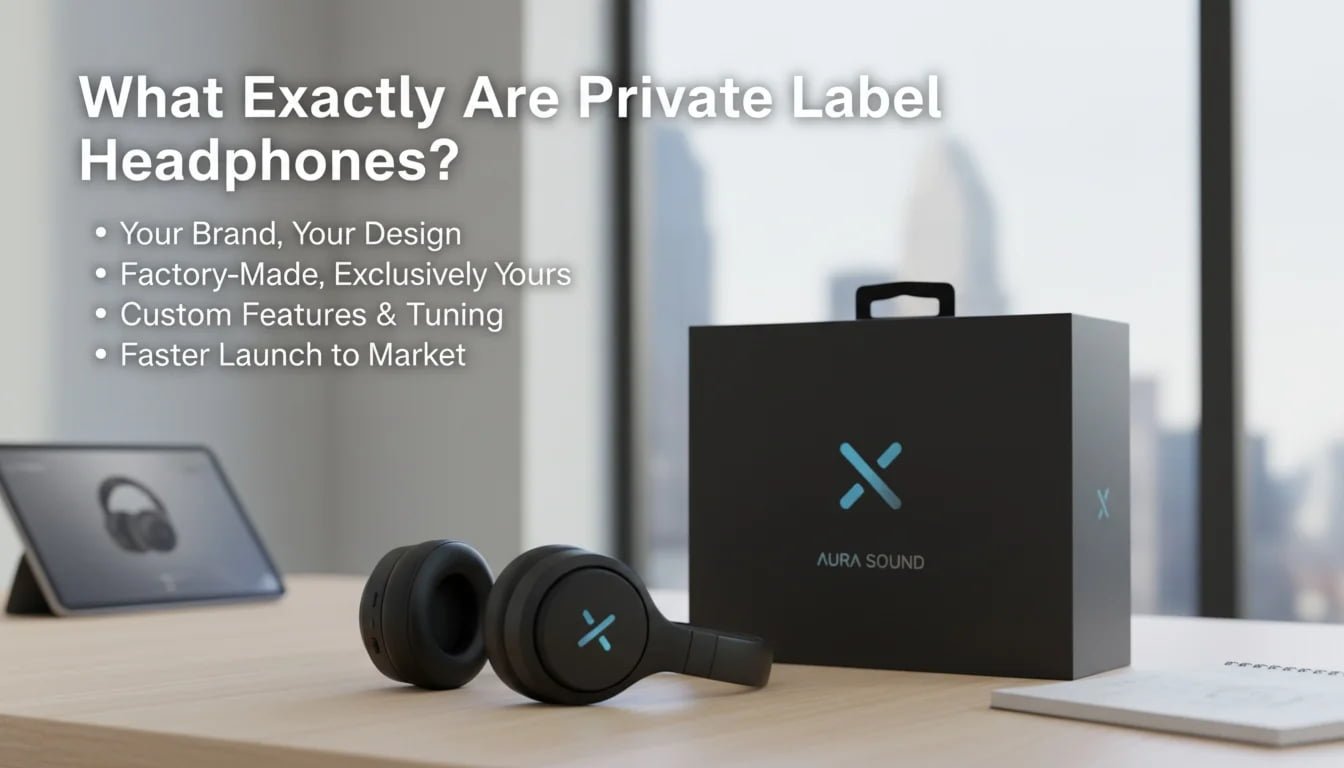
When you choose the private label path, you're not just putting your logo on a random product. You are in the driver's seat from the very beginning. I remember working with a client from Europe who was passionate about creating headphones for classical music fans. He was obsessed with getting the mid-tones and treble just right. We went through three rounds of acoustic tuning5 and tested four different speaker drivers to achieve the sound he envisioned. That is the power of private label. You control every detail to create a product for your specific customer.
This process is a deep partnership. You bring the vision, and a factory like mine brings the engineering expertise. We handle the industrial design, mechanical structure, electronics, and acoustics based on your requirements. We also implement strict quality control6 at every stage, from inspecting incoming raw materials to testing every single unit before it ships. This is how brands like Huawei build and maintain their reputation for quality. It requires a bigger investment and more time upfront, but the result is a product that is truly yours, builds brand loyalty, and can't be easily copied by competitors.
Key Aspects of Private Label1
| Feature | Description | Benefit for Your Brand |
|---|---|---|
| Unique Design | You control the product's entire look and feel. | Creates a strong and memorable brand identity. |
| Custom Tuning | You decide the exact sound profile (bass, treble, etc.). | Perfectly appeals to your specific target audience. |
| Strict Quality Control | You set the high standards for materials and performance. | Builds customer trust and a reputation for quality. |
| Market Exclusivity | No one else in the world can sell your exact product. | Eliminates direct, look-alike competition. |
What About OEM2 Headphones Then?
Need to sell headphones fast and on a tight budget? Creating a brand-new design is too slow and expensive. OEM2 is your solution for a quick and affordable market entry7.
[OEM](https://www.reddit.com/r/headphones/comments/b5h0th/what_is_an_oem_and_can_i_trust_it/)2 (Original Equipment Manufacturer) headphones use a factory's existing molds and designs, which we call "public molds8." You just add your logo. It's fast and cost-effective, but your product might look the same as others. It's ideal for those not focused on building a unique brand or top-tier audio.
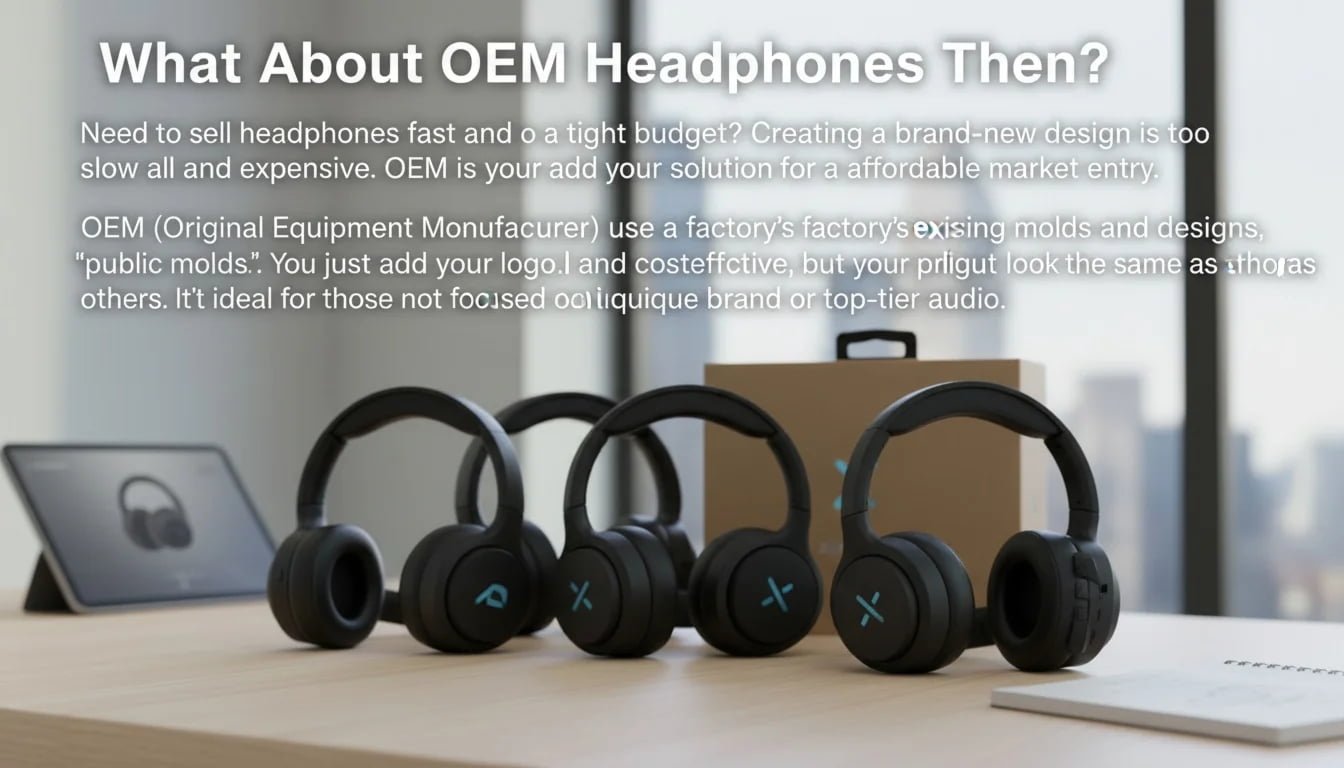
The biggest advantages of OEM2 are speed and low cost. In my factory, we have a large library of these "gong mo," or public molds8. These are headphone designs that are already engineered, tested, and ready for mass production. You can pick a model you like, we put your brand's logo on it, and you can have a product ready to sell in a few weeks, not many months. The main downside is that another company can come to us, or another factory, and use the exact same mold. This means your headphones could look identical to a competitor's, with only the logo being different.
But here is a secret many new buyers miss: OEM does not have to mean "basic" or "low quality." A very smart client of mine picked one of our popular TWS earbud molds. He knew his customers cared most about battery life9 and call quality. He asked us to upgrade the battery for 8 hours of playtime and use a better chipset with noise-canceling microphones. For a small extra cost per unit, he launched a product that performed like a premium brand10 but at a much lower price. This is how you use OEM2 smartly. You can get a brand-equivalent product for a fraction of the cost, making your customers very happy.
OEM Customization Levels
| Level | What You Can Change | Best For |
|---|---|---|
| Basic OEM2 | Your logo and custom packaging. | Maximum speed and the lowest possible cost. |
| Customized OEM2 | Battery, speaker drivers, Bluetooth chip11, colors, finish. | Getting the best balance of cost, speed, and quality. |
| Full OEM2 (ODM) | Major changes to internal and external parts. | Creating a semi-unique product12t](https://www.euromonitor.com/article/the-fight-for-headphones-supremacy---design-as-a-differentiator-in-tws-earbuds)%%%FOOTNOTE_REF_4%%% without new mold costs. |
So, How Do I Choose The Right Path For My Business?
Still trying to decide between Private Label1 and OEM2? Making the wrong call can set your business back. Let’s break it down with a clear decision guide right now.
If your main goal is to build a long-term brand13 with a unique product4 and a premium feel, choose Private Label1. If you need to enter the market quickly, test a new idea, or compete on price, choose a customized OEM2 model. You can always start with OEM2 and move to Private Label1 later.
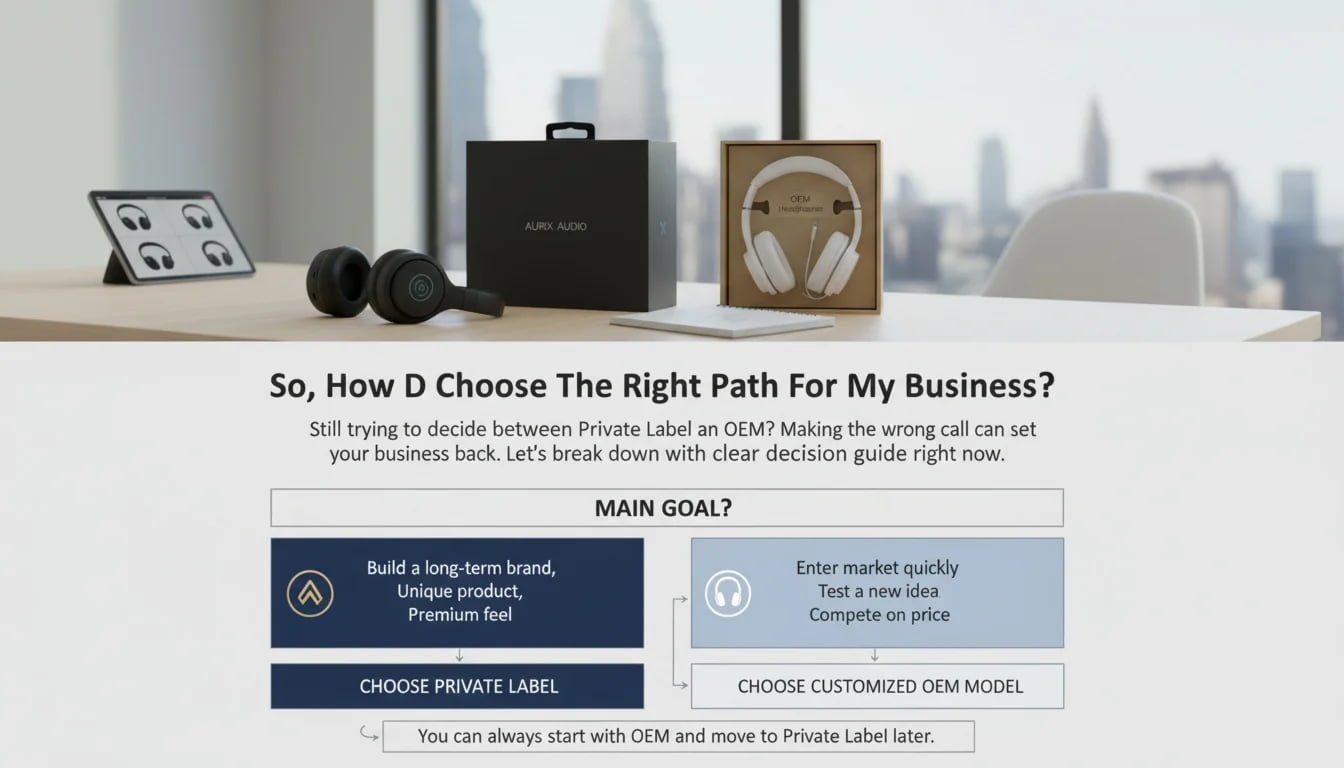
The choice really comes down to four simple things: your budget, your brand goals, your timeline, and your customer. You have to be honest with yourself about each one. A few years ago, a startup with a great brand idea but a small budget came to us. They wanted to jump straight to a fully custom private label design. I advised them to start with a customized OEM2 model first. They took my advice, launched a product quickly, made some money, and learned a lot about what their customers wanted. A year later, they came back to me. With their profits and market knowledge, we started development on their first true private label headphone.
Starting with OEM2 is not a failure. It can be a very smart first step. It’s a low-risk way to get into the market and test your ideas. In all my years running this factory, I’ve seen more clients succeed by starting small and smart than by betting everything on one big, expensive idea from the start. Use this table to think about your own business.
Private Label1 vs. OEM: A Direct Comparison
| Factor | Private Label1 | OEM |
|---|---|---|
| Brand Identity | Very Strong and Unique | Weak to Moderate |
| Upfront Cost | High (mold fees, R&D) | Very Low (no mold fees) |
| Time to Market | Slow (6-12+ months) | Fast (1-3 months) |
| Product Uniqueness | 100% Exclusive to You | Not Unique (shared mold) |
| Best For | Building a long-term, premium brand10 with high margins. | Quick market entry7, testing ideas, competing on price. |
Conclusion
In short, Private Label1 builds your unique brand identity for the long term. Smart OEM, on the other hand, offers a fast, affordable, and high-quality alternative. Choose the path that best fits your business goals and budget today.
Explore the advantages of Private Label headphones for brand control and uniqueness. ↩
Learn about OEM headphones and how they can provide a cost-effective solution for your brand. ↩
Understand the importance of brand control in creating a successful headphone product. ↩
Discover why uniqueness can set your headphone brand apart from competitors. ↩
Find out how acoustic tuning enhances sound quality in headphones. ↩
Learn about effective quality control measures to ensure product excellence. ↩
Discover effective strategies for entering the competitive headphone market. ↩
Understand the concept of public molds and their role in OEM production. ↩
Discover tips for enhancing battery life in your headphone designs. ↩
Understand the characteristics that make a headphone brand premium. ↩
Find out key factors to consider for Bluetooth chip selection in headphones. ↩
Explore the concept of semi-unique products and their market advantages. ↩
Get insights on strategies for establishing a lasting headphone brand. ↩